
In Part I, I talked about how finding people who share our values to be our peers has become much easier in the age of the Internet, and how that isn’t conducive to consensus-based democracy; this is because of radicalization. The internet makes radicalization easier not because of misinformation or crazy conspiracy theories, but because humans are built to be easy to radicalize, and our defenses against it can only be consciously exercised.
We’re a tribal and ground-minded species
That’s why (online) communities exist, that’s why companies employ Community Managers, it’s a successful industry because of that fact. The internet just makes aggregation and finding those like-minded people easier. Much easier. The very nature of human groups is to be radical, we automatically seek to define the in-group and the out-group, my people, not my people. The opinion about you of the peers whom you hold in high esteem is what matters to you – side tangent: that’s why being “canceled” is worn as a badge of pride by folks – and when people can find social circles and peers that don’t challenge their views, that’s what they’ll believe. This breaks democracy’s ability to find a path forward from a starting point of disagreeing views. You already want to believe in your peers, you hold them in high esteem, if you don’t consciously scrutinize information, you will believe in misinformation. This doesn’t breed consensus; it breads radicalization and tribalism. The people who live near and disagree with you, the thousands of people online that disagree with you, the loud shouts, the fighting, all of that only breeds resentment. You’ve found the people who truly matter. Others are just wrong, because they aren’t in-group, they’re a threat.
Add all of that to the fact that one nutjob in a community who believed a shadow-y government controlled the weather, no one would really listen to them. They would not get the national relevance to be able to find other people who believed them. The news wouldn’t give them airtime. But now they can, and worse off, a lot of people whose values are shared by people who believe insane things are pressured (not consciously or explicitly, simply by human community seeking) to start believing it, because that’s what their peers whose values they share and whose opinions about them matter to them believe. I’m essentially describing community theory. So… people start believing misinformation, not because they truly do on reasonable grounds, but because peer-social pressure makes them inclined to believe it. Because if the “enemy”, the “others”, the out-group doesn’t believe it, well, then the others are obviously wrong. Our current online rhetoric – on both sides – only reinforces this. We constantly paint those who disagree with us as enemies, we call for their annihilation, we wish gross misfortune upon them.
And thus, we get to why I don’t think misinformation matters that much to electoral results, people are not choosing their candidates because of what misinformation they believe in, but rather because the peers who share their societal and moral values also believe in that candidate. It isn’t the misinformation that causes their choices, but the other way around, their values and the current environment make people seek out those who agree with them, the rest are seen as enemies to be defeated. That makes them more prone to believe in misinformation. I’ve myself fallen prey to this; I believed for months in something that had already been debunked by Reuters because it nicely fit with what I thought a candidate would behave. The truth is that they hadn’t behaved that way, but I believed that they did, because my circle was saying so, and I trusted the people who were saying so. I never checked. I should have.
If that is true, then misinformation shouldn’t be judged on its surface level, it should be judged deeper. One example: there’s a lot of people in Brazil worried about “Communism” or “Turning into Venezuela”, if you ask them what communism is, they’ll get it wrong, and then their vocalized hatred towards communism gets dismissed because they’ve been manipulated into hating communism without even knowing what communism truly is. Because of this interpretation, we assume that the solution is information, if we could properly inform and educate those people, then they would vote “correctly”. They wouldn’t hate communism and fall for fearmongering against it. This is the battle that assumes that misinformation shifts voters significantly. I pose that’s wrong.
Values and beliefs are what matters
It doesn’t matter what communism truly is, it matters what those people think it is, and what they’ve been told it is and why they’re against that. Their values are not necessarily truly against communism (though it might also be), what is communism or not is a red herring. Their description of communism is pretty close to what left-leaning parties in Brazil actually do propose (sprinkled with a lot of exaggerations and demagogy). So, what they’re truly saying, is that they don’t like the values that the left parties are spousing. Communism is just an easy straw-man name to refer to, it isn’t really what their morals are against.
What their morals actually are is what matters, and they seek groups online who share those moral values, and when found, there’s pressure to believe what that group believes – be it absurd or not. People aren’t scientifically judging moral and political claims, they’re believing what’s comforting to believe, what already resonates with their values. That being the case, then efforts to spread true information, educate, and confront people with the truth are misguided. The belief that if only they could see the truth, then they would vote for us (the left) is misguided.
This notion that our challenge is to educate people with facts is also seen as disrespectful, the working men described above isn’t going to take well to the idea that he’s stupid and because he’s stupid he’s voting wrongly. This isn’t an education problem, it’s a values problem. The more the left continues to pose itself as being the enlightened ones who solely possess the truth, the more this gap grows into an uncrossable chasm. Their issues aren’t dumb and believe in misinformation, their issues are they’re not seeing how democracy helps them, they’re not seeing their values reflected in government, they’re not seeing their lives improve (on the contrary), and so they turn to populists who promise they have the answers. This time, the populists are conservative far-right authoritarians.
So, rather than my argument being that the internet has not allowed for a rise in misinformation (it unquestionably has) I think it is shallow and wrong to say that is the cause or the problem resulting in the rise of conservative subversive authoritarians – yes, I called them conservative-subversive, and I think it’s correct. They have conservative morals, but are subversive in terms of traditional democracy, they’re not democratic, they want to subvert the government in an authoritarian shift). In this case, misinformation is merely a form of expression that doesn’t meaningfully cause the problems we see and the rise of far-right authoritarians. What truly matters is why people have become so willing to believe irrationally unhinged things that would otherwise have no credence. My proposition is that that’s because of human-socialization patterns that favor the development of exclusionary groups that instinctively force adherence and compliance, and how the internet (and largely social media algorithms) potentializes that beyond anything we’ve ever seen before.
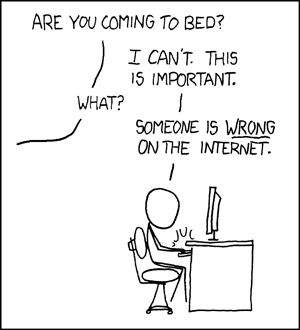
If we are looking for something on social media platforms to blame, I’d pose it’s news feed algorithms who have the larger role in this. Our shared understanding and beliefs around “bubbles” is incorrect. There’s ton of discourse online on how the algorithm only shows you things you already agree with and thus forms uniform thinking bubbles. That’s patently not true, and demonstrably so. Algorithms are machine-learning things with a given goal: increase engagement and screen time. More engagement and more screen time means you see more ads and platforms have bigger inventories to sell. Showing you things you viscerally disagree with is a great way of doing that. “Someone’s wrong on the internet” is a meme for a reason (xkcd 386). We often get confronted with things that enrage or emotionally deeply affect us on social media, see any comment section. That fact that that happens leads to further tribalization, because now it’s about defending one’s people against the other people (who are wrong). When that happens, reason and rationality go out the door, there’s no logical standards that won’t be ignored in the efforts of defending one’s people against people who are perceived as an aggressor who’s a threat.
Homogeneity through tribalization leads to forced conformity, and tribalization against a perceived threat favors the most radical views. Forced conformity to most radical views leads to the rise of authoritarian radicals. Not the misinformation. It’s our desire for our peers to be right and to be accepted that makes us radicals. You join that with coordinated misinformation, a refusal to make concessions, to listen, and to recognize that not everyone who disagrees is an enemy… and Liberal Democracy will have a hard time surviving.
1 thought on “The failures of Democracy, misinformation, and the role of social media in it all (Part 2)”